Your Custom Text Here
The Mermaid Times: Puppet History - From Mermaid Theatre to the Canadian Museum of History


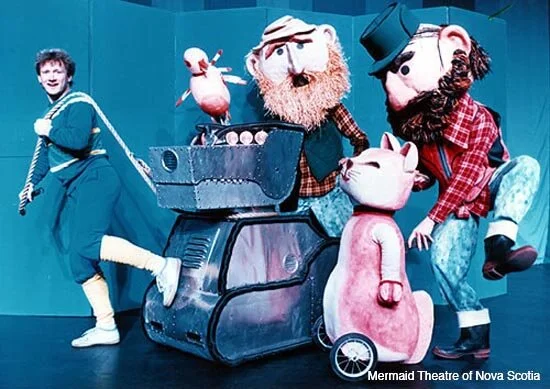
There’s a unique puppet in the Canadian Museum of History that was created here at Mermaid Theatre. Tom Miller (co-founder of Mermaid Theatre) created a "mouth and rod" puppet for the production of Glooscap's People, Madoonak the Stormmaker (remounted as The Wabenaki).
A mouth puppet has a distinguishable mouth that uses flexible materials which allow for manipulation of the puppet’s mouth.
The rod puppet is a puppet that has a rod attached to the limbs and can be manipulated by the puppeteer to move its arms.
If you want to move the other limbs on the puppet, it will require the help of another puppeteer.
Learn more information: https://www.historymuseum.ca/collections/artifact/231833/?media_irn=326260
Pictures retrieved from: https://www.historymuseum.ca/collections/artifact/231833/?media_irn=326260
The Mermaid Times - Origin of Puppets
There is a vibrant and rich culture about the origins of puppets, but conflicting theories still persist. It is hard to pinpoint the exact geneses of puppets and puppeteering due to many influences from several different cultures.
German Richard Pischel (1849-1908) an Indologist, believes they originate from India. The Sanskrit names “sutradhara” meaning he who holds the strings, and “sutraprota” meaning puppet (Union Internationle de La Marrionette - UNIMA).
Another theory suggested by researchers Hermann Reich (1868-1934) and Berthold Laufer (1874-1934), believe there is a dominant Greek culture influence (UNIMA).
Originally puppets were not used as entertainment pieces as they are in some performances seen today, however they were more commonly used for religious/ceremonious purposes, or as ancient idols.
Learn more information (click here) : https://wepa.unima.org/en/origins-of-the-puppet/
Know any other origin stories of puppets? Let us know!